Racket Sports Club Pricing Strategy: How to Set Court Prices That Maximize Revenue
Introduction

Pricing is the most powerful lever for racket sports club revenue. Yet most clubs set prices once and forget about them.
If you manage a club, you know the pain: courts sit empty during off-peak hours, peak times are underpriced, and you're not sure if your pricing strategy is actually maximizing revenue.
The right pricing strategy can increase revenue by 20-40% without adding a single court. The wrong strategy leaves money on the table or keeps courts empty.
This guide breaks down the exact pricing strategies that work for padel, tennis, pickleball, squash, table tennis, badminton, and beach tennis clubs — with real numbers and implementation steps.
The Pricing Framework
Every racket sports club needs four pricing tiers:
1. Peak Pricing
When: Evenings (5-9 PM), weekends, holidays.
Why: Maximum demand. Players expect to pay more. Your courts are most valuable during these hours.
How much: 30-50% above base rate.
Example: If your base rate is $25/hour, peak rate is $32-38/hour.
2. Off-Peak Pricing
When: Weekday mornings, early afternoons.
Why: Low demand. Empty courts generate zero revenue. Discounted prices fill courts.
How much: 20-40% below base rate.
Example: If your base rate is $25/hour, off-peak rate is $15-20/hour.
3. Member Pricing
When: All times for registered members.
Why: Members are your most valuable customers. They book more often and spend more overall.
How much: 10-20% below non-member rates.
Example: If your non-member rate is $25/hour, member rate is $20-23/hour.
4. Premium Pricing
When: Tournament courts, priority booking, special events.
Why: Some players will pay more for guaranteed quality or convenience.
How much: 20-30% above peak pricing.
Example: If your peak rate is $35/hour, premium rate is $42-46/hour.
Sport-Specific Pricing Strategies
Padel Club Pricing
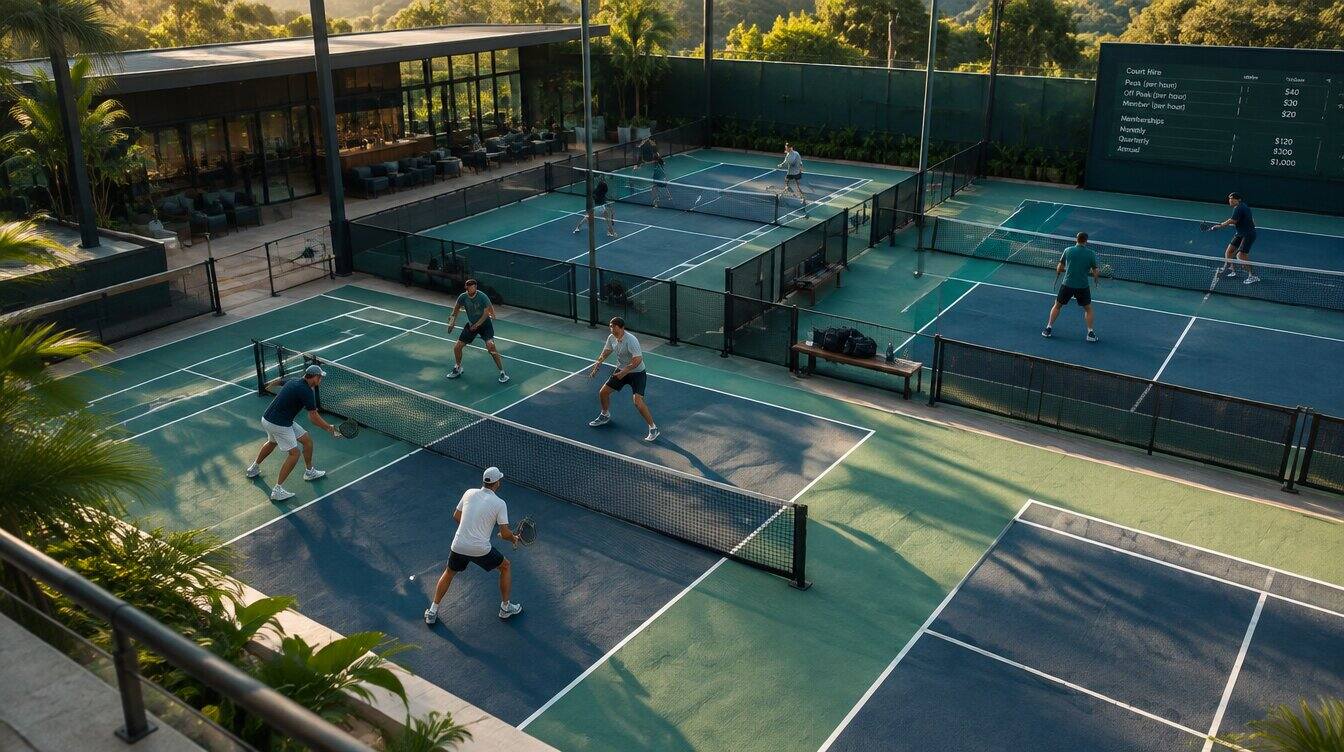
Base rate: $25-40/hour for doubles.
Peak premium: +30-40% for evening and weekend slots.
Off-peak discount: -30% for weekday mornings.
Member discount: -15% across all times.
Special considerations: - Group bookings (4 players) can have flat-rate pricing - Floodlit courts can command $5-10/hour premium - Seasonal pricing for outdoor courts (summer vs. winter) - Tournament pricing is separate from regular bookings
Revenue impact: A padel club with 6 courts implementing this pricing structure can increase revenue by 25-35% within the first quarter.
Tennis Club Pricing
Base rate: $20-35/hour for singles, $30-50/hour for doubles.
Peak premium: +25-35% for evening and weekend slots.
Off-peak discount: -25% for weekday mornings.
Member discount: -10% across all times.
Special considerations: - Court surface pricing (clay courts often command premium) - Floodlit courts can command $5-10/hour premium - Lessons have separate pricing structure - Seasonal pricing for outdoor courts
Revenue impact: A tennis club with 6 courts implementing this pricing structure can increase revenue by 20-30% within the first quarter.
Pickleball Club Pricing
Base rate: $15-25/hour for doubles.
Peak premium: +30-40% for evening and weekend slots.
Off-peak discount: -30% for weekday mornings.
Member discount: -15% across all times.
Special considerations: - Indoor courts often priced higher than outdoor - Equipment rental can be bundled with court time - Group clinics have separate pricing structure - Open play sessions can have flat-rate pricing
Revenue impact: A pickleball club with 8 courts implementing this pricing structure can increase revenue by 25-35% within the first quarter.
Squash Club Pricing
Base rate: $15-25/hour.
Peak premium: +25-35% for evening and weekend slots.
Off-peak discount: -25% for weekday mornings.
Member discount: -10% across all times.
Special considerations: - Court quality matters more than surface type - Ball rental can be included or charged separately - League play often has discounted rates - Box league participants may get special pricing
Revenue impact: A squash club with 4 courts implementing this pricing structure can increase revenue by 20-30% within the first quarter.
Table Tennis Club Pricing
Base rate: $10-20/hour.
Peak premium: +25-35% for evening and weekend slots.
Off-peak discount: -25% for weekday mornings.
Member discount: -10% across all times.
Special considerations: - Equipment rental (paddles, balls) can be bundled - Multi-table bookings can have volume discounts - Coaching has separate pricing structure - Competition play may have different pricing
Revenue impact: A table tennis club with 8 tables implementing this pricing structure can increase revenue by 20-30% within the first quarter.
Badminton Club Pricing
Base rate: $12-22/hour.
Peak premium: +25-35% for evening and weekend slots.
Off-peak discount: -25% for weekday mornings.
Member discount: -10% across all times.
Special considerations: - Shuttlecock costs can be included or charged separately - Multi-court bookings can have volume discounts - Coaching has separate pricing structure - Mixed doubles leagues may have special pricing
Revenue impact: A badminton club with 6 courts implementing this pricing structure can increase revenue by 20-30% within the first quarter.
Beach Tennis Club Pricing
Base rate: $20-35/hour.
Peak premium: +30-40% for evening and weekend slots.
Off-peak discount: -30% for weekday mornings.
Member discount: -15% across all times.
Special considerations: - Seasonal pricing (summer vs. winter) - Equipment rental can be bundled with court time - Tournament pricing is separate from regular bookings - Weather-dependent scheduling affects pricing
Revenue impact: A beach tennis club with 4 courts implementing this pricing structure can increase revenue by 25-35% within the first quarter.
Dynamic Pricing Strategies
Time-Based Dynamic Pricing
Implementation: Adjust prices based on demand in real-time.
When to use: When courts are consistently full during peak times.
How it works: If a time slot is 80%+ booked, increase price by 10-15%. If below 50%, decrease by 10-15%.
Result: 15-25% revenue increase without adding courts.
How PlayGeko handles it: Set pricing rules based on utilization thresholds. System adjusts prices automatically. Players see current prices in real-time.
Volume Pricing
Implementation: Discount for bulk bookings (10+ hours).
When to use: When you have corporate clients, leagues, or regular groups.
How it works: 10 hours = 5% discount. 20 hours = 10% discount. 50 hours = 15% discount.
Result: Guaranteed revenue, higher utilization, loyal customers.
How PlayGeko handles it: Create booking packages with automatic discounts. Players purchase packages online. System tracks usage and applies discounts.
Early Bird Pricing
Implementation: Discount for bookings made 7+ days in advance.
When to use: When you want to fill courts early in the week.
How it works: 10% discount for bookings made 7+ days ahead.
Result: Better planning, reduced last-minute cancellations, higher overall utilization.
How PlayGeko handles it: System applies discount automatically based on booking date. Players see the discount and are incentivized to book early.
Last-Minute Pricing
Implementation: Discount for bookings within 2 hours of play.
When to use: When courts are empty and won't fill otherwise.
How it works: 20-30% discount for bookings within 2 hours.
Result: Fills otherwise empty courts. Revenue is better than zero.
How PlayGeko handles it: System applies discount automatically when courts are empty within 2 hours. Players see the discount and are incentivized to book.
The Psychology of Pricing
Price Anchoring
Show the highest price first. When players see $40/hour peak rate, $25/hour off-peak feels like a deal.
Implementation: Display peak pricing prominently. Show off-peak as "Save $15/hour" rather than just showing the lower price.
Bundling
Sell 10-hour packages at a discount. Players feel they're getting value. You get guaranteed revenue.
Implementation: Offer 10-hour packages at 10% discount. Players purchase packages online. System tracks usage.
Membership Value
Position membership as "unlimited access" rather than "discounted rates." The word "unlimited" feels more valuable than "10% off."
Implementation: Create membership tiers with "unlimited" benefits. Show the value of unlimited access vs. per-booking pricing.
Social Proof
Display average booking prices. When players see most bookings are $25-30, that becomes the reference point.
Implementation: Show average prices on your website and app. Highlight popular booking times and prices.
The ROI of Smart Pricing
Here's the math for a typical 6-court club:
| Metric | Before | After | Improvement |
|---|---|---|---|
| Average hourly rate | $25 | $30 | +20% |
| Court utilization | 55% | 65% | +18% |
| Monthly revenue | $22,000 | $31,200 | +42% |
| Annual revenue | $264,000 | $374,400 | +$110,400 |
ROI of PlayGeko Professional ($94/month): - Investment: $1,128/year - Revenue increase: $110,400/year - ROI: 9,787%
Frequently Asked Questions
How often should I adjust prices?
Review prices quarterly. Adjust based on demand patterns, competition, and seasonal changes. Don't change prices too frequently — it confuses players.
Should I offer discounts for new players?
Yes. A first-time discount (20-30% off) reduces the barrier to entry. Once they experience your facility, they'll book at full price.
How do I handle price increases?
Announce 30-60 days in advance. Explain the reason (improved facilities, expanded hours). Grandfather existing members for 3-6 months.
What's the best way to test pricing?
A/B test with different groups. Offer one price to half your members, another price to the other half. Measure booking rates and revenue.
Should prices include equipment?
Consider bundling basic equipment (balls, shuttlecocks) with court time. It simplifies pricing and increases perceived value.
Related articles

The Future of Padel: Market Trends and Opportunities for Club Owners
How to Price Your Padel Courts: Peak vs Off-Peak Strategy